Story and photos by Pete Shaw
September 29, 2025
Dear Dad,
How do I describe Marseille? It hit me a bit like New York City. The greeting was not so flagrant and aggressive as The City’s, but similar contours were discernible. Or at least at this early morning hour, I seem to believe that. But the fact is that I have been, since 3:30 AM, trying to make some sense of this place for you.
Then, it may have only seemed similar because we had landed in Paris earlier in the day following a nine hour overnight flight, a couple of short train rides to Paris Gare de Lyon, and then a high speed rail that three and a half hours later dropped us off here, in St. Martin’s Station. Only a few moments after emerging from the station, trying to get oriented, some young person rode a fast and lengthy wheelie on his electric scooter. It gave me a slight jolt. If I was not familiar with the singularity of the act–New York always hits me like a wall, and this was more like walking into a lamp post–the lower volume did not affect my recognition of the melody.
I smiled. Marseille!
“We” is not just Jessica and me. Howard came along for the ride. You remember Howie, my good Friend from college who grew up near mom’s folks? Him. The madman on the scooter had not impressed him. In fact, he seemed scandalized. Howie still lives in Brooklyn, and all else is but a cheap imitation. The brazen insolence of the rider–This? This is your idea of trying to make your case for my walking into a human blender? I eat that shit for breakfast.–had clearly aroused his contempt.
A few months earlier, Howie had expressed some trepidation. He was worried that being from the United States might result in us dealing with unpleasant situations. I assured him that most people understood the difference between people and their governments. (Oh yeah, Trump, yeah that one, got re-elected in 2024.) Then he got worried about how he would be treated as a Jewish person. “Nonsense,” I said. “Europe has a long history of kindness toward the Jewish people.”

The young rider had set the tone well. There is a near-palpable chaos-that-works feeling here. Driving a car would is usually the best way to notice this. We do not have a car, but an equally reasonable gauge of a city’s entropy is how safe you feel when traversing a crosswalk. In Rome it seems like a good idea to launch prayers toward St. Peter’s before stepping off the curb. In Marseille, although the option is readily available from its many churches and other religions’ houses of worship, just keeping hyperaware of traffic at all times should handle most situations.
Marseille is alive, vibrant. It is a riot of sensory input. It has its own peculiar, difficult to describe rhythm. People have been coming to this ancient port city for thousands of years, and and their cultures have permeated. There are numerous ethnic minorities in the city center, many from north Africa. It is supposedly the highest ethnic minority populated city center in Europe. The African influence is clear. And from my limited experience, there is a deep Italian feel to the place, and an equally Spanish one too. It feels less formal than Paris, but there is surely something very French going on. Everything is still done with style, but often from different angles than you find in Paris.
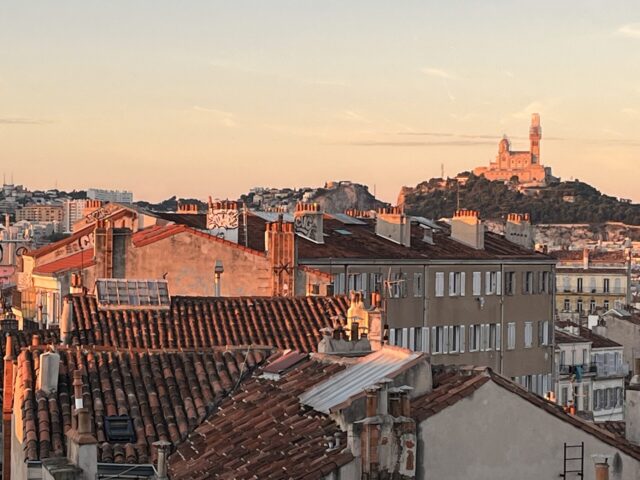
The apartment we rented is at the top of its building, fifth story. There is no elevator, so we have to climb about 100 steps to reach it. The reward is a lovely view of the Old Port and the Mediterranean Sea. At night from this height the view is serene. Morning light turns the water azure, and to the right in my view, for a short time, it looks magenta. The red ceramic rooftops that help define any aerial view of the city glow, and the various antennas, plants, clotheslines, and most alluringly, the chimneys, look remarkable. To the left, on the highest point in the city, sits basilica Notre-Dame de la Gard basilica. Not far from it are the well-preserved remains of the fort that guarded the port. Readiness next to godliness, indeed.
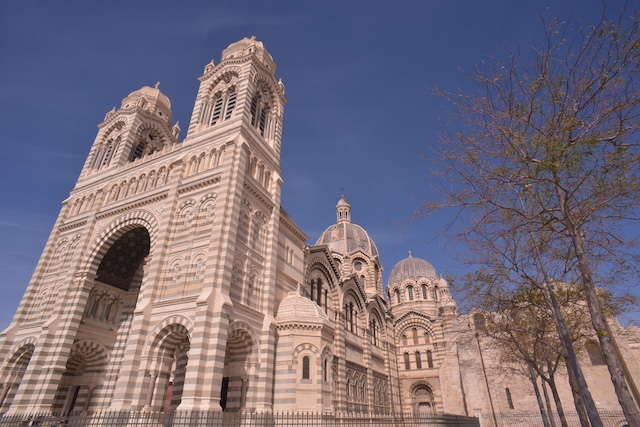
To the right, St. Martin’s station seems much further away than I thought following our walk from the train to here. The Church of Saint Vincent DePaul appears huge, particularly its two large white steeples which stand slightly out of proportion to the buildings around it. But Cathédrale La Major, near where the Old Port meets the Mediterranean, fits. It is not as majestic as Notre-Dame de la Garde, but it more than holds its own. Its black and white stripes draw the eye.
It is a magnificent view.
Not far from here is Noailles, a neighborhood with a heavy north African vibe. It is lovely. The people, not surprisingly, were friendly, and they appreciate friendliness. I do my best in French, which is not far from the result likely brought by asking one of our cats to do her best recitation of Bob Dylan lyrics. But when that fails, as it quickly does, a smile will go a long way.
A young person sitting on a stoop asked me if I like Marseille. I told him I love it. I ran by him and gave him a short list of particulars including the beautiful way it confused me. He smiled and gave me a thumbs up. When I told him I grew up near New York, he got excited. Everywhere I have been, from western New York to Paris to East Bumblefuck, The City is a place of Magic. Ten minutes later we parted ways, and I moved along, better than I was prior to meeting him.
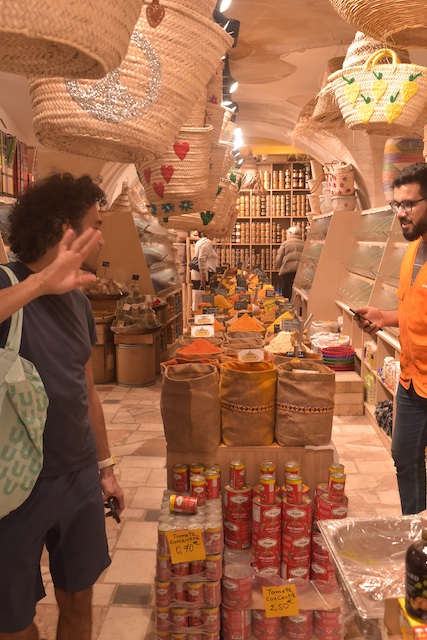
A few moments later Jessica and I were in a small Tunisian grocery store. It has much of what would be the usual stuff in the US, although the many baskets hanging from the ceiling called for attention. But what really stands out is the island running down the middle of the room. It has an array of bags with colorful spices in them, many of them seeming to glow. I commented to the person working how beautiful it was. Or I tried to. I said, “Plus belle.” Jessica stepped in to say, “Tres belle.” While I am sure he was pleased with my saying the spices were more beautiful, for a moment he probably wondered, “More beautiful than what?” I laughed, thanked Jessica, and repeated, “Tres belle. Tres belle!”
We spent one day in the old neighborhood, La Panier, the bread basket. A place of winding, ancient streets. One of the neat things about Marseille, and every other city or town I’ve visited in this country, is how short the streets are. Not that the streets themselves cover short distances, but rather that outside of more main roads–think the Rue de Rivoli in Paris–you cannot go more than a few blocks before a street changes its name. In La Panier, Rue Saint-Antoine becomes Rue des Belles Ecuelles which a few blocks later becomes Rue du Panier. You can cross the Rue du Panier from the south along the Rue des Muettes and once on the other side find yourself on the Rue Puits du Denier and quickly, the Rue de la Vieille Tour.
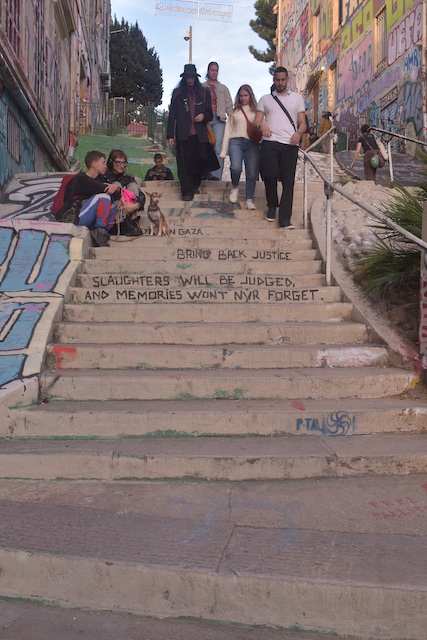
There’s a lot of history in all that. And while the frequent changes can make coping with a map challenging, in nearly all cases when traveling, I find the best solution is to just toss the map in the knapsack and wander, reveling in the possibility that every step may result in a surprise. And when you calibrate your spirit to that setting, the rewards come often.
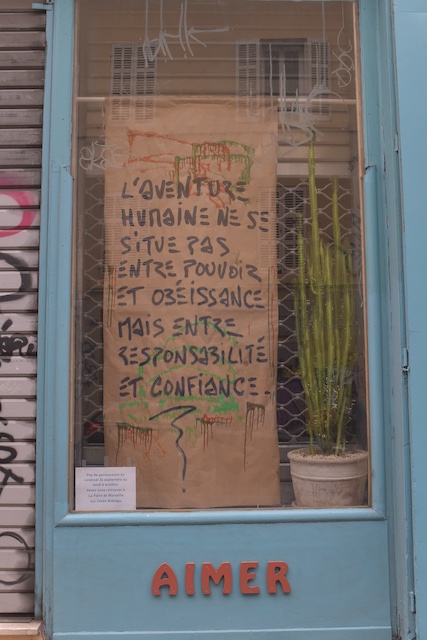
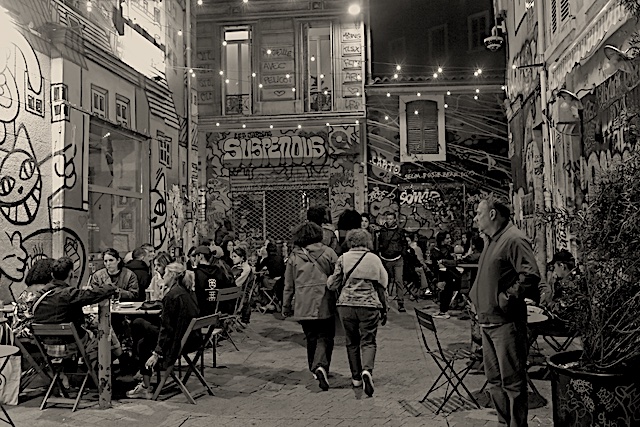
Graffiti, if that is the word for it, is big here. My circumspection is because some of the graffiti is sanctioned. I am sure there have been battles fought over the idea that graffiti by definition must run afoul of The Law. What is the line separating graffiti and street art here? I imagine it is little different than anywhere else. Whatever one calls it, it seems like it is everywhere. Much of it is whimsical, but not art for art’s sake. After all, if graffiti is by definition not legal, then its very act is one of Resistance
As to be expected, there are also political statements. Many focus on the Palestinian people and Israel’s genocide of them. (Yes, you did help drop bombs on Germany when it was committing a genocide.) There is great discontent with the French government, particularly its president. A surging fascist party in France finds Resistance on walls and sidewalks and parks and squares. It is often sobering.
I am taken in by all of it. Most cities are museums unto themselves, exhibits changing by the moment. But I have never been in a city that had close to as much as wall art as Marseille.
Not surprisingly, a lot of languages are spoken here. It’s like hearing different sorts of music. I have little to no idea what is being said, but that is just fine. The many paces, rhythms, and dynamics are navettes for the ears. Another input, another smile.
When we travel, I have very few things I need to see and do. One of them here was to get a t-shirt for Finn featuring Erik Cantona, one of the greatest soccer players of all time. He was born in Marseille. I enjoy seeing any reasonable activity performed at a high level, and to boot, no pun intended, Cantona once drop kicked a Nazi sort in the stands. Better, he was absolutely unapologetic about it. I got into a lengthy conversation about Cantona and anti-fascism with the clerk. As with so many people we have met in this city, he felt sorry for us having to endure Donald Trump. But he was glad to hear that people are Resisting.
Just up the street from where we are staying is a large square, Place Jean-Jaurès. People gather on it, sitting on benches, playing soccer, jumping around on the playground, and so on. Along some of the perimeter are cafes, bars, and restaurants. As with the other similar squares we passed through, the tables outside the eating and drinking establishments are often filled. There is a sense of Community that I feel is missing in much of the U.S. Just being around it is invigorating.
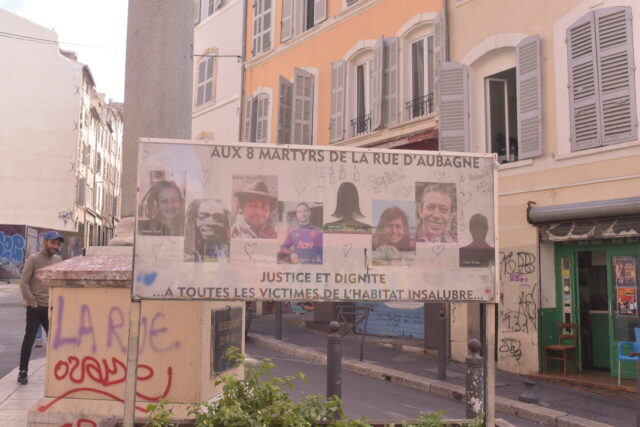
Of course, nothing is perfect. Quite a few times we’ve passed a stark reminder of this, an ad hoc memorial to the “martyrs” of Rue d’Aubagne. That street runs through the Noailles district. The population has a high ethnic minority composition, and not surprisingly, much of the housing is not well-maintained by landlords or the City. In the morning of November 5, 2018, 63 and 65, rue d’Aubagne collapsed. While 63 was unoccupied, 65 was not. Eight people died. Following the collapses, city officials evacuated over 4,500 people from 578 buildings in the city that were deemed dangerous. Most of those people who were evacuated were ethnic minorities. A report from the High Committee for the Housing of Disadvantaged Persons released on November 21 stated that “the collapses of the buildings on rue d’Aubagne were not accidental and unforeseeable events. They resulted from a continuity of dysfunction from public actors.” Those public actors are Marseille’s city council and the French government.
I’ve lit a few candles at churches for you and mom. I don’t believe they will come to anything in terms of divine intervention. But it is always nice thinking of you and her. And I think you would agree that if it was the least I could do, it was Right that I also lit one for those eight people who lost their lives too soon, to in some small way offer to the universe that their lives mattered.
Here is another interesting, small way. We passed the empty lots where those buildings once stood, where the eight deceased and the survivors once lived. The aerial view on Google’s map program shows the empty lots. If you go down to street level on the map, a half block from the addresses, you still can see the empty lots. But when you directly face what should be the empty lot, the buildings are there. 63 appears lifeless. The two windows on the second floor are covered with plywood. The remaining three stories have missing windows. The facade’s paint has fallen off in many places. The top looks ready to buckle.
65 appears better maintained, but again, the upper two floors look ready to buckle. On the first and third floors, drying laundry hangs from the windows. People lived there. They raised families there. They ate there. They argued there. They Loved there. They slept there. And at least eight people died there. They mattered.
In a few hours we will head back to the train station and head east to Cannes. There we will rent a car and drive inland to a “perched village” named Tourettes-sur-Loup.
Despite choosing the scattershot items above, and choosing them from a far larger list of images dancing across my mind, I have no answer to this moment’s ultimate question: What is this place? I am not sure how I would even go about that. I feel if I lived here the rest of my life, I could not provide an answer.
Of course, that is of no matter. I know I like Marseille. That is all I need know.
Love,
Peter