Story and photos by Pete Shaw
When President Franklin Roosevelt signed Executive Order 9066 on February 19, 1942, he set into motion the United States government’s rescinding of the constitutional rights of 120,000 people of Japanese descent in the US, two-thirds of whom were US citizens. They were not convicted of any crime. They were never accused of one. Nonetheless, they–particularly those Japanese Americans living along the US West Coast–were deemed a national security threat.
At least in the dominant narrative, the next part of the story usually finds these people of Japanese descent imprisoned in ten war relocation centers largely in the western states, although there were also two in Arkansas. Through the hard work of organizing by activists and historians among many others, most of all the people who survived their imprisonment, the names of some of these war relocation camps and the memories and histories of the people who endured them were not thrown into the dustbin of history.
Yet from all that work and its important achievements, a question of time emerges. In August 1942, over 13,000 people of Japanese descent, mostly from the Pacific Northwest, were taken to the Minidoka War Relocation Center in southern Idaho. Varying numbers were imprisoned in eight of the other relocation camps between May and September, with the Jerome relocation center in Arkansas opening in October.
So what happened to these 92,000 Japanese Americans who called West Coast home between Executive Order 9066 and the opening of these relocation camps? In short, they were rounded up and imprisoned in what the US government called assembly and reception centers.
On Saturday March 14, a group of 75 people gathered in the basement of the Epworth United Methodist Church in Southeast Portland to learn about some of the work being done to shed more light on these short-term camps, including one in Portland. The Japanese American Museum of Oregon (JAMO) hosted the event featuring filmmaker and producer Sharon Yamato, photographer Stan Honda, and content director for Densho, Brian Niiya.
Niiya said the assembly centers exist because of “the government decision to forcibly remove Japanese Americans from the West Coast,” but the government had made no plans as to how this would happen. The Western Defense Command, which was in charge of removing them, “assumed initially that Japanese Americans would be able to voluntarily move themselves,” and created the Wartime Civil Control Administration (WCCA) to facilitate their migration..
It soon became clear these people were not going to self-deport. Niiya noted that not only did most of these West Coast Japanese not have family or friends elsewhere, but as well the leaders of most states neighboring the West Coast states “were vehemently opposed to Japanese Americans living in their states.”
The WCCA needed to act quickly, and so it quickly built 15 temporary assembly centers and one reception center. Most of them were in California, with the other two assembly centers in Portland and Puyallup, Washington. The reception center was in Arizona. The camps were mostly built on existing facilities such as fairgrounds and race tracks, usually near the communities from which their inmates were taken. They were open between 1 and 7 months, and ranged in size from the Mayer Assembly Center’s population of 250 people to over 18,500 people at the Santa Anita Assembly Center.
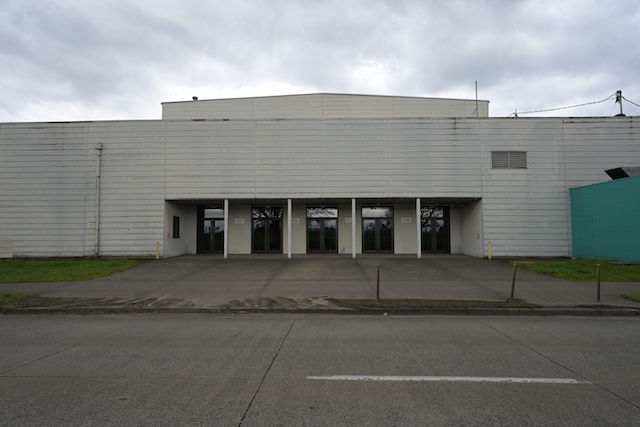
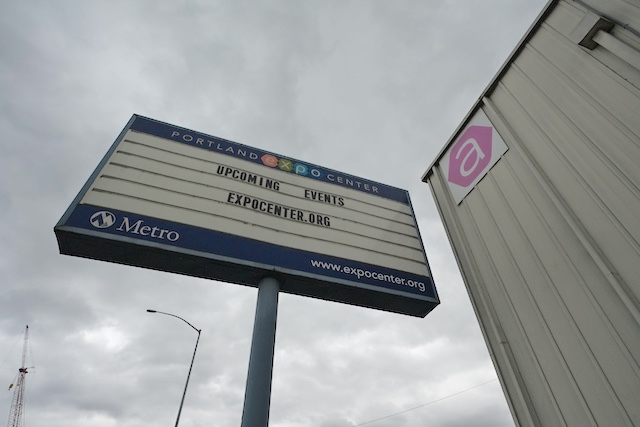
Oregon’s assembly center was at the Pacific International Livestock Exposition Pavilion in North Portland, its structures now part of the Portland Expo Center. For four months, almost 3,700 people of Japanese descent from much of Oregon and Washington were imprisoned in the stockyards that are now Halls A and B of the Expo Center before being transferred to the war relocation centers; most to Minidoka, some to Heart Mountain and Tule Lake, in Wyoming and California, respectively.
Yamato described the camps as “put together with Scotch tape” which “many would describe as worse than the permanent ones.” She added that of this terrible lot, she considered Portland’s assembly center to be among the worst.
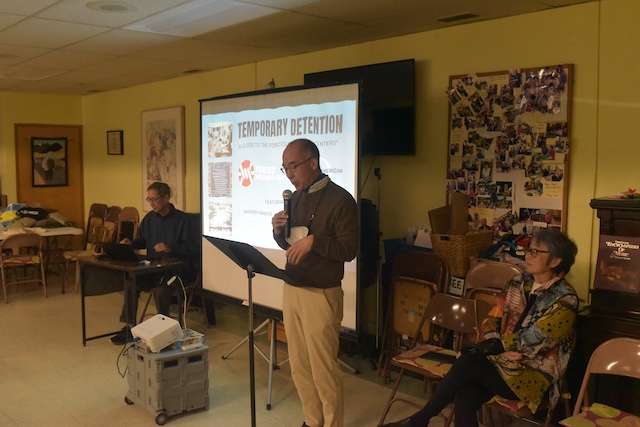
Kay Endo, who grew up in Milwaukie, was 8 when he was taken to the Portland Assembly Center. He was one of two people in the audience who had survived the camp. Endo recalled first being taken to the Multnomah County Fair Grounds in Gresham before being transferred to Portland. One thing that still stands out to him was that when eating meals in the mess hall, people had to sit with their families. At Minidoka, however, “We sat with our buddies.”
Endo talked about the gym with a basketball court that was erected in what is now the Expo Center’s Hall C, and the baseball field outside. He also poignantly remembered looking out the entrance to the assembly center, which faced north. “We could see Jantzen Beach Amusement Park, and we could see the ferris wheel and things like that. It was lit up at night, and that was very interesting.” That memory nearly oozes with nostalgia and idyll until you consider that Endo’s view would have been partially obscured by barbed wire and perhaps a guard tower or a security guard. He also noted the living quarters not having doors, but rather, canvas sheets. There was even less privacy in the group showers and restrooms.
Niiya spoke of other survivors of the Portland Assembly Center recalling the intense heat that built up inside the barracks. Unlike some of the other camps at fairgrounds and horse racetracks, the Portland Assembly Center was enclosed. It lacked the aeration the other more open to the air sites did, and at times the barracks reached as high as 107F. On those occasions, the prisoners were granted 90 extra minutes to mill around outside beyond the usual 10 PM curfew.
No matter the temperature, with the barracks built atop a dirt floored stockyard that usually housed cattle, horses, pigs, and sheep, the rank smell of excrement filled the barracks. If your olfactory sense was lacking, there were always the fly infestations that sometimes covered up the lightbulbs.
Each person who was imprisoned in each assembly center had a history. “A huge range of size,” said Niiya, “and a huge range of experiences.” Among many, the work of Yamato, Honda, and Niya reminds us that each person who was in an assembly center has a history.
Yamato said the project began coming together in 2021 when Niiya, with whom she’s “been working sort of together for the past 30 years,” told her the assembly centers were largely not talked about and that they should work to change that.
“As I began doing research on this,” said Niiya, “it became clear that this story was just not being talked about much.”
And who better to photograph than Honda, whom Yamato met in 1993 when both were “in the middle of this incredibly, horribly, awful place in Powell, Wyoming, also known as Heart Mountain to help move the barrack that was found at Heart Mountain to the Japanese American National Museum.” Honda had been taking photos, and upon seeing them Yamato “couldn’t bear for them to go unpublished,” resulting in a book and a film, both titled Moving Walls.
Soon, all three hit the road, taking three different drives to see all of the camps. Niya insisted that to better understand what assembly center prisoners endured “we have to go in the Summer when there’s no air conditioning.”
Honda, who had never been to an assembly center prior to this project, showed off the website that has come from their work. It combines first hand accounts from survivors, histories of each site, contemporary photos of the camps, and Honda’s present-day photos of the sites.
Shabby and awful as Portland’s and all the assembly and reception centers were, they were also sites of resistance. About 20 years ago my father and I took in an exhibit at the Oregon NIkkei Legacy Center (which later became JAMO) about all the ways the prisoners in the Portland Assembly Center resisted their oppression. It is always moving seeing such defiance. No matter its size, each act matters and adds up. So many years after the assembly centers shuttered, Yamato, Honda, and Niiya’s website is a powerful tool, and it stands as another example of that resistance insisting attention be paid.
After showing a touching but also humorous documentary film dealing with the history and legacy of the assembly and reception centers that she produced–The Misadventures of a Nisei Week Queen–which was showing at the DisOrient Asian American Film Festival of Oregon in Eugene the next day, Yamato mentioned other projects bringing information about the assembly and reception centers to a wider audience.
The San Joaquin Fairgrounds in Stockton, California are the only other assembly center site beside Portland with extant buildings People are working to make a state park, memorial, museum, and community center at a warehouse-sized building that once served as a hospital for the assembly center’s 4,271 inmates.
And in Tulare, California, a group of students taking a cultural history course at Mission Oak High School were shocked to find that the county fairground three miles west of their classroom was once used to imprison nearly 5,000 Japanese Americans. Starting in 2016, the class’s students–who according to Yamato are mostly Latino with none of them Japanese American– have worked to raise awareness of the camp and erect a memorial at the fairgrounds.
“They knew this had happened there,” said Yamato. “And there is absolutely no marker, no nothing there, which is why they wanted to make sure that people realized this was a detention site.”
Then she threw down something like a gauntlet. “We were at Portland this morning,” she told the crowd. “It’s really kind of a shame there’s only a little, tiny plaque there. I would love to see something more extensive.” It didn’t take much fine tuning to hear what Yamato had really said: If these Tulare high school punks can do it, what’s your problem?
Glad you asked. Lynn Fuchigami Parks, a former executive director at JAMO and currently a Cochair of the Metro Historical Significance & Mobilization Committee (HSMC) advising the Metro Council and the Metropolitan Exposition Recreation Commission (MERC) on the Expo Future Project, had some good news. According to a resolution adopted by the Metro Council in January, the plan is to redevelop the 53 acre Expo Center site as a “community-centric destination venue that prioritizes amateur, professional, and recreational sports” venue. The resolution “directs staff to ensure that implementation of actions pursuant to sports uses at Expo is supportive of and compatible with the representation and memorialization recommendation presented to the Metro Council and MERC on December 10, 2024, and that staff endeavor to accomplish expansion of sports uses and representation and memorialization of the site’s histories and cultures in a way that does not commodify or cause harm to involved partners and communities.”
Putting together those recommendations entailed HSMC reaching out not only to the Japanese American community, but also to the community of Vanport survivors and the Native American Tribal communities, as the location “was in all of their histories.”
“So we spent 15 months doing outreach, questionnaires, interviews with all the different communities,” said Parks, “and put a report together, and we submitted it to Metro Council. They adopted it and made resolutions regarding the redevelopment of the site and the Portland Assembly Center.” In the report, HSMC recommends that “Expo’s future include memorialization and representation of Impacted Communities: urban Indigenous, Japanese American and Vanport Communities, the three primary groups with significant historical ties to Expo Center and its surrounding land and water” with the goal of honoring “the past and present experiences of Impacted Communities, to create access and opportunities to facilitate recognition and to provide opportunities to engage with visitors on the site.”
Parks said the plans for the site include “everything from art, architecture, murals, gardens, programming, and potentially an interpretive center.” The project still has a way to go, but Parks sounded optimistic when she said, “All this work is signed and ready to move forward.”
In the HSMC’s November 2024 Recommendations Report, one of the “Community-Suggested Implementation Strategies” includes telling “the histories and personal impacts so that past harms are not repeated.” In any time this seems an important, good, and correct idea. At times like this one, when the US government is again snatching and removing and rounding up people and families from their homes and communities, and often placing them in camps whose existence and squalor bear an uncomfortable and horrifying resemblance to the assembly and reception centers, it feels more urgent.
One week later the Japanese American Historical Plaza in Tom McCall Waterfront Park was hopping. It was one of those days we get in these parts around this time of year when it seems the entirety of Portland declares an end to the rainy season. The sun was bright, the sky a magnificent and big blue, and our collective frisson of emerging from the damp times was palpable. Deep down we knew we were being silly. Or maybe just consuming a finely distilled carpe diem. But we all knew what must happen. No doubt this early candidate for most gorgeous day of the year would be followed by a period of bastard weather, the overcast and rainy and dark days coming back, sneering, “Not so fast,” a cycle that will go around a few more times most years.
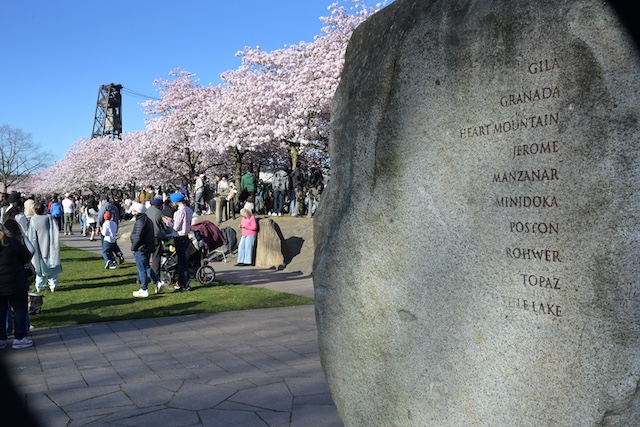
But that reckoning was for another time. For now, you couldn’t paint a prettier day. But if you decided to break out your brushes and oils, you’d better have packed your reds and whites. The cherry blossoms along Waterfront Park’s approach to the Steel Bridge, planted for the plaza’s consecration on August 3, 1990, had just bloomed a cloud of sublime pink. They were both dazzling and meditative. A sight to behold, to ponder. Sacral.
Herds of University of Texas basketball fans, in town for the first two rounds of the men’s college basketball tournament, wandered across the Steel Bridge. They presented a poetically incongruent sight, roaming among and admiring the 100 flowering Akebono while wearing shirts and hats bearing their team’s brand, a vaguely menacing pair of horns from a Bos taurus.
Among the large basalt and granite stones in the plaza, many bearing poems by former prisoners of the concentration camps, is one inscribed with the names of all ten War Relocation Centers. The Japanese American Historical Plaza was dedicated three years after President Ronald Reagan signed the Civil Liberties Act that acknowledged the historical wrong the United States had committed upon the Japanese Americans it had incarcerated. Accounts often refer to Reagan or the US government giving the apology as well as some financial recompense as if an act of munificence. In fact, it was the organizing and activism of people over decades that compelled the US government to amend to some small degree the injustice and suffering it had brought upon these people when it denied them their due process, stripped them of their freedom, and rejected their humanity.
One week later, on one of those predictably dreary days, I found myself at the MAX Yellow Line’s Expo Center station. The torii gates, their 3,500 metal identification tags hung from wire shimenawa between the hashira, and their metal-pressed copies of contemporary newspaper articles surrounding a portion of the hashira that comprise the late Valeri Otani’s Voices of Remembrance which usually greet you at the station have been temporarily deinstalled for maintenance. Only their nemaki and their ensconced bottoms of the hashira remain. On a day like this, were the gates in place, the light breeze would cause the tags to jingle lightly.
Torii gates are often used to mark sacred spaces. If you know what happened here between May 2 and September 10, 1942, their absence makes this place no less hallowed.
If.
The Expo Center is a short jaunt across a parking lot from the MAX station. Something called Thriftapalooza was wrapping up in Hall D. Outside of Hall C, which connects to Hall D, some of the event’s vendors were loading their vehicles. Though the sound of bouncing basketballs was long gone, their echoes live on with Kay Endo and other survivors of the assembly center, as well as in the Densho Encyclopedia and Yamato, Honda, and Niya’s forced assembly centers website.
I figured Hall A was locked, so I walked west along North Marine Drive, toward Hall B. I came to a bank of doors at what once marked the entrance to the Portland Assembly Center. I walked across the road, scaled the berm, and looked across the Columbia River to Jantzen Beach. Its big box and other stores stand atop what author John R. Powers might have called the area’s biggest graveyard of laughter. I thought about how almost 84 years earlier Endo too had gazed across the water, although because he was among the over 120,000 people of Japanese descent in the US declared a threat, he was denied the freedom to take up my position. Endo had said he’d found the distant sight of the amusement park “interesting.” A loaded word that one, its context beyond my ken.

In point of fact, Hall A was locked. Years ago, shortly after visiting the exhibit at the Oregon Nikkei Historical Center, my father and I bore witness to the historic marker inside Hall A, and paid respect to the people and the injustice done unto them, which the plaque addressed. Their resistance and their resilience, unmentioned. It felt paltry, its own injustice awaiting redress.
The Japanese American Museum of Oregon is located at 411 NW Flanders Street. It is open Wednesday through Saturday from 10 AM to 4 PM, and on Sunday from 11 AM to 4 PM.